

The Scottish Budget for 2026/27 brings further changes to Income Tax, continuing the gradual divergence between how Scottish residents are taxed compared with the rest of the UK.
While the headline message from the Scottish Government is that most people will pay less Income Tax, the reality depends heavily on where your income sits. For some, the changes will offer modest savings. For others, particularly higher earners, the gap between Scotland and the rest of the UK will continue to widen.
Here’s what’s changing and what it means in practice.
How Scottish Income Tax works
The starting point for Income Tax is the same across the UK.
The personal allowance, currently £12,570, is set by the UK government and applies equally in Scotland, England, Wales and Northern Ireland.
Above that, Scotland sets its own Income Tax rates and bands on non-savings, non-dividend income such as employment income, self-employed profits and pensions.
Scotland currently uses five Income Tax rates, compared with three in the rest of the UK.
What’s changing from April 2026
The Scottish Government has announced increases to the thresholds for the lower tax bands, meaning more income will be taxed at lower rates.
From April 2026:
- The basic rate band (20%) will rise from £15,398 to £16,537
- The intermediate rate band (21%) will rise from £27,492 to £29,527
- The higher rate (42%) will still start at £43,663
- The advanced rate (45%) and top rate (48%) remain unchanged
This means Scottish taxpayers will pay the lowest 19% starter rate and 20% basic rate on a slightly larger portion of their income.
The Scottish Government estimates that around 55% of taxpayers will pay less Income Tax than people elsewhere in the UK as a result of these changes.
Scotland vs the rest of the UK: what do people actually pay?
The key difference is where the tipping point sits.
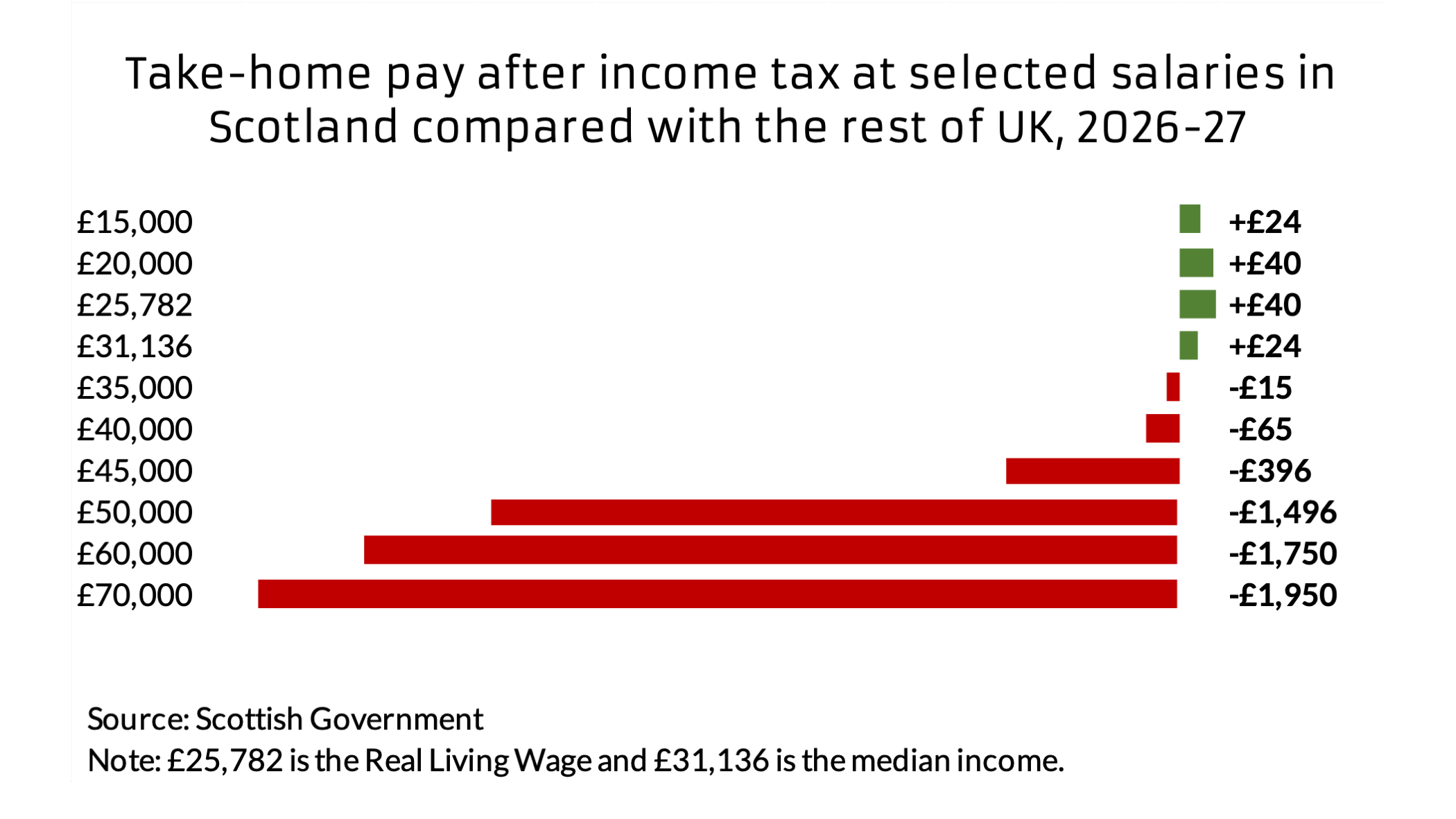
Lower and middle earners
If you earn below roughly £33,500, you are likely to pay slightly less Income Tax in Scotland than if you lived elsewhere in the UK.
The saving is modest, typically up to around £40 per year, but it does mean Scotland remains marginally more favourable for lower earners.
Higher earners
Once income rises above that level, the position reverses. For example:
- Someone earning £50,000 in Scotland will pay almost £1,500 more Income Tax than someone earning the same amount in England, Wales or Northern Ireland.
- The gap widens further as income increases, due to the higher 42%, 45% and 48% rates applying earlier and more aggressively than elsewhere in the UK.
In short:
- Lower earners tend to be slightly better off
- Higher earners pay significantly more
Why the Scottish Government is doing this
The Scottish Government’s stated aim is to protect lower earners and raise additional revenue from those with higher incomes.
Finance Secretary Shona Robison said the changes were designed to ease pressure on household budgets while asking “those with the most to contribute that little bit more.”
Independent analysis suggests the income tax changes will raise:
- Around £72 million in 2027/2028
- Rising to around £200 million per year thereafter
However, economists have also pointed out that overall public spending remains under pressure, with cuts elsewhere in day-to-day budgets.
Other tax measures worth noting
Alongside Income Tax, the Scottish Budget also confirmed:
- New council tax bands from April 2028 for homes valued over £1 million
- A proposed air departure tax, including a private jet levy, with Highlands and Islands exemptions
- Continued business rates relief for retail, hospitality and leisure premises
- Increased funding for health, transport and childcare, alongside efficiency savings across the public sector
While these measures won’t affect everyone directly, they form part of the wider tax and spending landscape Scottish residents and business owners need to be aware of.
What this means for you
If you live and work in Scotland
- If your income is modest, you may see a small reduction in Income Tax
- If your income is higher, particularly above £43,663, your overall tax bill will remain higher than elsewhere in the UK
- Salary increases, bonuses and pension income may push more income into higher Scottish bands
If you are a company director or self-employed
- Scottish income tax applies to your salary, self-employed profits and pension income
- Dividend tax rates remain UK-wide, but the interaction between salary and dividends is more important than ever
- Careful planning is needed to avoid drifting into higher Scottish tax bands unnecessarily
If you are considering relocating
- The income tax difference between Scotland and the rest of the UK is now material at higher income levels
- Any move should be considered alongside housing costs, lifestyle and long-term plans, not tax alone
Planning ahead
Income tax in Scotland continues to move in a different direction to the rest of the UK. While the latest changes soften the impact for lower earners, higher earners and business owners will continue to feel the difference.
Understanding where your income falls, how it may change, and how different sources of income interact is key to staying in control.
If you would like help reviewing your position or planning ahead for the 2026/2027 tax year, our team at SeavorChartered is happy to help. Contact us here.


